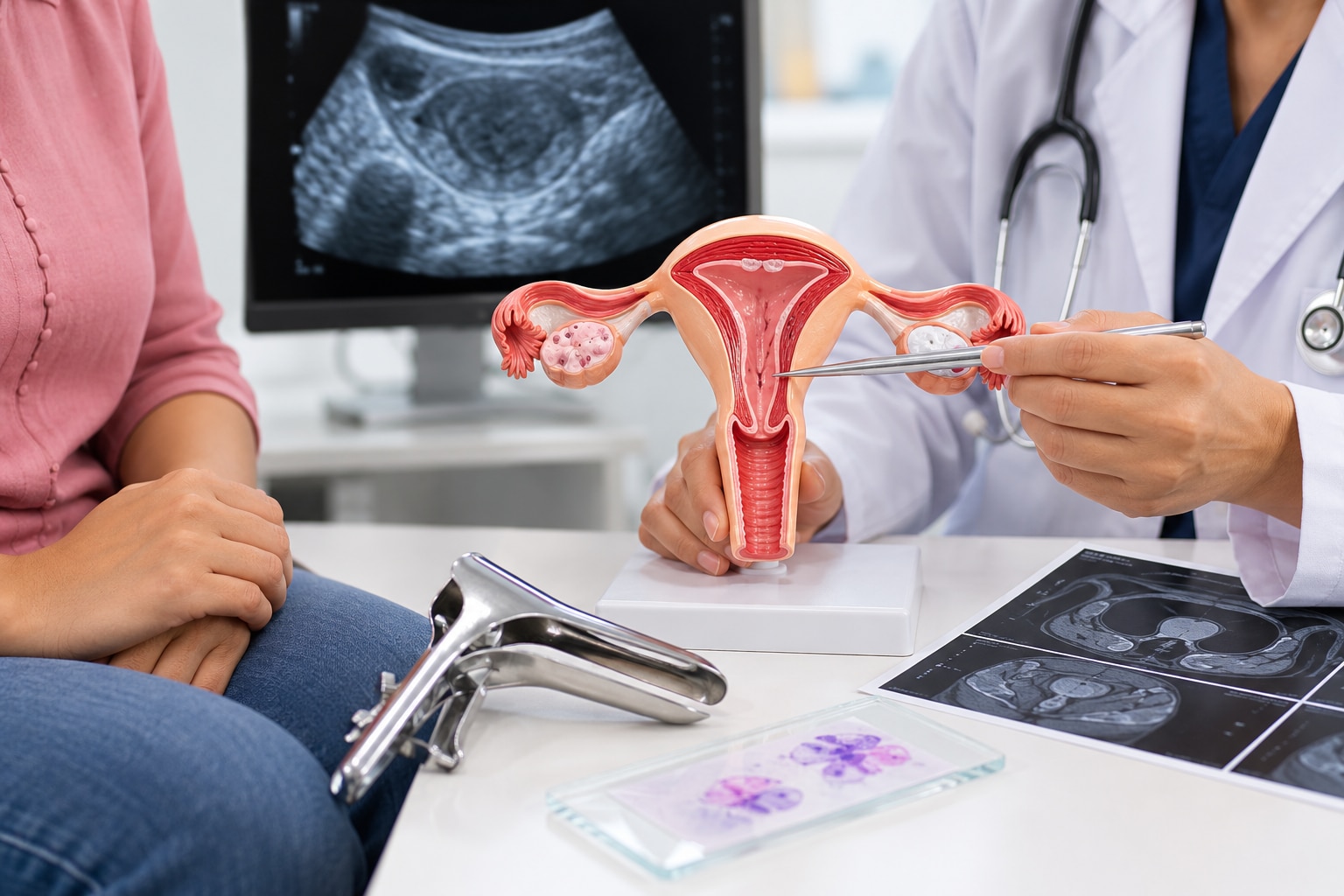
Before scheduling surgery, you need to establish whether the operation is for a clearly benign condition or whether symptoms, examination findings, or imaging require a cancer diagnosis first. The right pathway may include cervical screening, ultrasound, endometrial sampling, colposcopy, hysteroscopy, genetic assessment, or referral to a gynaecologic oncologist—not every test for every woman.
Key takeaways
- Routine cervical screening is different from tests for symptoms or suspicious findings.
- Postmenopausal bleeding requires diagnostic assessment before planning hysterectomy.
- Ask what an abnormal cervical test, biopsy, or ultrasound finding means for surgery.
- Confirm whether laparoscopic hysterectomy remains suitable if cancer is suspected.
Start by separating routine screening from diagnostic testing
The reason for surgery determines the cancer screening before hysterectomy. A woman without symptoms usually needs age- and history-appropriate cervical screening, while postmenopausal bleeding, persistent abnormal bleeding, an abnormal scan, or a suspicious examination finding requires diagnostic testing.
| Situation | Main assessment | What it can show |
|---|---|---|
| Routine review before surgery | Medical and family history, pelvic examination, and cervical screening with an HPV test or Pap test when due | Cervical precancer or cancer risk |
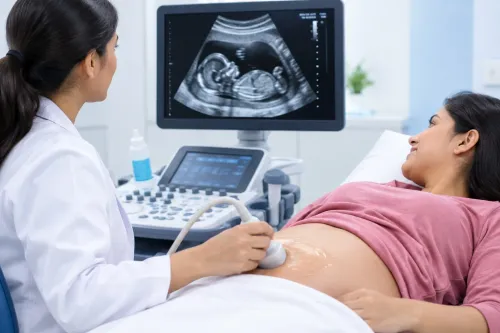
| Uterus, endometrium, ovaries, or adnexa need assessment | Transvaginal ultrasound | Structural findings such as fibroids, polyps, thickened endometrium, or an adnexal mass |
| Symptoms or suspicious findings | Endometrial sampling, colposcopy, cervical biopsy, or other directed testing | Tissue diagnosis rather than reassurance from a screening result |
A Pap or HPV test mainly evaluates cervical precancer and cancer. It does not screen for ovarian or endometrial cancer, and a normal blood count, ultrasound, or CA-125 result cannot provide general cancer clearance.
The operation also matters. Total hysterectomy removes the cervix; supracervical surgery leaves it in place and requires continued cervical screening. After total hysterectomy, surveillance depends on previous CIN2, CIN3, adenocarcinoma in situ, or cervical cancer. Without those histories, routine cervical screening is usually stopped, according to clinician guidance.
An overdue or abnormal cervical result needs appropriate follow-up before surgery. Do not treat hysterectomy as an automatic cure for an undiagnosed cervical cancer.
Match the tests to the reason for surgery and the bleeding pattern
The operation’s indication and bleeding pattern determine whether endometrial sampling belongs in cancer screening before hysterectomy. Fibroids, adenomyosis, endometriosis, or prolapse with reassuring symptoms and imaging may need a different work-up from heavy bleeding, irregular bleeding, or bleeding after menopause.
| Reason for surgery or symptom pattern | Tissue assessment before surgery | Key point |
|---|---|---|
| Abnormal uterine bleeding at age 45 or older | Endometrial sampling commonly warranted | Do not treat heavy bleeding as routine preoperative imaging |
| Younger patient with abnormal bleeding | Sample when bleeding persists, treatment fails, or obesity, chronic anovulation, polycystic ovary syndrome, or unopposed oestrogen exposure is present | Risk factors increase concern for endometrial overgrowth or cancer |
| Any postmenopausal bleeding | Evaluate after one episode; sample when indicated | An endometrial thickness of 4 mm or less on transvaginal ultrasound has greater than 99% negative predictive value in the appropriate initial evaluation, but recurrent or persistent bleeding still requires tissue assessment |
| Reassuring fibroid, adenomyosis, endometriosis, or prolapse symptoms and imaging | The work-up may differ from bleeding-driven evaluation | A benign surgical indication does not automatically require the same tests |
An office endometrial biopsy uses a narrow instrument passed through the cervix to collect lining tissue. Cramping and brief spotting are common, and many patients resume ordinary activity the same day. Because the sample is blind, it can miss a focal polyp or small lesion.
Hysteroscopy with directed biopsy is more useful when ultrasound shows a polyp, the sample is inadequate, or bleeding continues despite a benign result.
Know what abnormal cervical and ultrasound findings mean before surgery
A concerning Pap test, HPV result, pelvic examination, or scan needs a diagnostic plan before surgery. Complete an overdue cervical screen; do not treat it as an optional formality. An abnormal result may lead to repeat testing, colposcopy, and cervical biopsy.
Suspected cervical cancer needs a planned cancer operation, not an assumption that hysterectomy will cure an undiagnosed cancer.
Use this sequence before laparoscopic hysterectomy:
- Ask which finding needs clarification: a suspicious cervical lesion, persistent postmenopausal bleeding, an atypical uterine mass, or an adnexal mass with malignant features requires specialist review.
- Match imaging to symptoms. An endometrial polyp causing bleeding or showing concerning features usually needs removal or directed sampling. A thickened endometrium must be interpreted with age, menopausal status, bleeding pattern, and risks such as obesity or unopposed oestrogen exposure.
- Treat a complex ovarian cyst as a finding, not a diagnosis. Repeat ultrasound, specialist review, or additional evaluation may be appropriate; do not order CA-125 automatically.
- Obtain tissue when symptoms demand it. A normal ultrasound does not replace endometrial biopsy or hysteroscopy with directed biopsy, and a normal Pap or HPV result does not exclude ovarian or endometrial cancer.
There is no routine ovarian-cancer screening strategy for asymptomatic women at average hereditary risk. Ultrasound and CA-125 can produce false positives, unnecessary surgery, and have not shown a survival benefit. This separation of screening, diagnostic testing, and surgical planning is central to cancer screening before hysterectomy.
When a benign laparoscopic plan is no longer the right plan
A family history can change the operation, not just the screening checklist. Ask whether close relatives had:
- Breast or ovarian cancer
- Fallopian-tube or primary peritoneal cancer
- Colorectal or endometrial cancer
Several related cases, young diagnoses, or endometrial and colorectal cancers clustering in one family justify hereditary-risk assessment, genetic counselling, and testing for syndromes such as Lynch syndrome. That is more useful than ordering tumour markers indiscriminately.
| Finding | Why the benign plan changes | Next step |
|---|---|---|
| Postmenopausal growth or unexplained bleeding | A fibroid-like mass can rarely be leiomyosarcoma, and imaging cannot reliably distinguish every leiomyosarcoma from a fibroid | Obtain specialist review before minimally invasive removal |
| Atypical uterine or adnexal imaging | The diagnosis may require tissue assessment or a different surgical route | Review scans and pathology with the treating specialist |
| Suspected cancer | A routine hysterectomy may not remove disease adequately or provide proper staging | Refer to a gynaecologic oncologist for a planned cancer operation |
Power morcellation requires particular caution. The rotating blade can fragment an occult uterine malignancy and spread it through the abdomen.
The FDA advises against power morcellation in postmenopausal patients or patients older than 50; when it is considered for an appropriately selected patient, use a legally marketed containment system, and never morcellate when malignancy is suspected.
For laparoscopic hysterectomy in Nashik, the key question is not whether laparoscopy is available. It is whether that route is safe for the suspected diagnosis.
Questions to ask before choosing gynecology surgery in Nashik
Ask these questions before choosing gynecology surgery in Nashik:
- Which diagnosis is driving surgery: fibroids, adenomyosis, endometriosis, prolapse, heavy bleeding, or suspected cancer?
- Is my cervical screening current, and do I need an HPV test, Pap test, colposcopy, or cervical biopsy before surgery?
- Will the cervix be removed? If it remains, what screening will I need afterward?
- Does my bleeding require endometrial sampling, especially if I am aged 45 or older or have postmenopausal bleeding?
- Is hysteroscopy with directed biopsy more suitable than a blind office sample?
| Test or approach | What it can show | When to ask about it |
|---|---|---|
| Office endometrial biopsy | A small tissue sample, but it can miss a focal polyp or small lesion | Persistent bleeding, risk factors, or a thickened lining |
| Hysteroscopy with directed biopsy | Directly views the cavity and samples a polyp or suspicious area | An abnormal scan, inadequate sample, or continuing bleeding |
Ask the surgeon to explain every ultrasound finding, including an endometrial polyp, thickened lining, complex ovarian cyst, or atypical uterine mass. Request the pathology report from every previous biopsy, and ask who will review an abnormal Pap, HPV result, or suspicious lesion.
Confirm whether a gynaecologic oncologist should be involved, how tissue will be removed, and whether power morcellation is planned. It can spread an occult uterine cancer.
Bagul Nursing Home & Dr. Bagul’s Hope IVF Center is one Nashik setting where you can discuss fertility, gynaecological evaluation, and surgical planning with your treating team. Take your results, symptoms, age, menopausal status, and family history to every consultation; choose a documented diagnosis-led plan, not simply the earliest laparoscopic slot.
Related services
Laparoscopy Laparoscopy Gynaecological surgeries like myomectomy and hysterectomy are done by minimal invasive techniques like laparoscopy as per patients conditions and... |
Hysteroscopy Hysteroscopy Done for diagnostic as well as therapeutic purpose for patients having conditions such as infertility, abnormal uterine bleeding, post menopausal... |
Frequently asked questions
What is the difference between routine screening and diagnostic testing before hysterectomy?
Routine screening checks women without symptoms according to age and medical history. Diagnostic testing investigates postmenopausal bleeding, persistent abnormal bleeding, abnormal scans, or suspicious examination findings.
Which tests are matched to the reason for hysterectomy and bleeding pattern?
The evaluation depends on whether surgery is planned for symptoms such as fibroids or heavy bleeding, or for findings that could indicate cancer. Your clinician may use cervical screening, pelvic examination, ultrasound, endometrial sampling, or other diagnostic tests based on the specific concern.
What do abnormal cervical and ultrasound findings mean before surgery?
An abnormal result does not by itself prove cancer. It identifies a finding that needs the correct follow-up, such as repeat assessment, colposcopy, biopsy, or further imaging before the surgical approach is finalised.
When might laparoscopic hysterectomy no longer be the right plan?
A suspected or confirmed cancer, extensive disease, or an unclear diagnosis can change the operation, surgical team, staging plan, or route of surgery. Ask whether tissue diagnosis and specialist cancer planning are needed first.
Related services
Treatment for Gynaecological Conditions Treatment for Gynaecological Conditions Gynaecological surgeries including D and E, Myomectomy, Hysterectomy and other are performed here by our doctors. View service → |
Gov. Approved Centre For Family Planning Gov. Approved Centre For Family Planning Family Planning surgery (Tubectomy) by laparoscopy or open method is done. View service → |
Keywords